
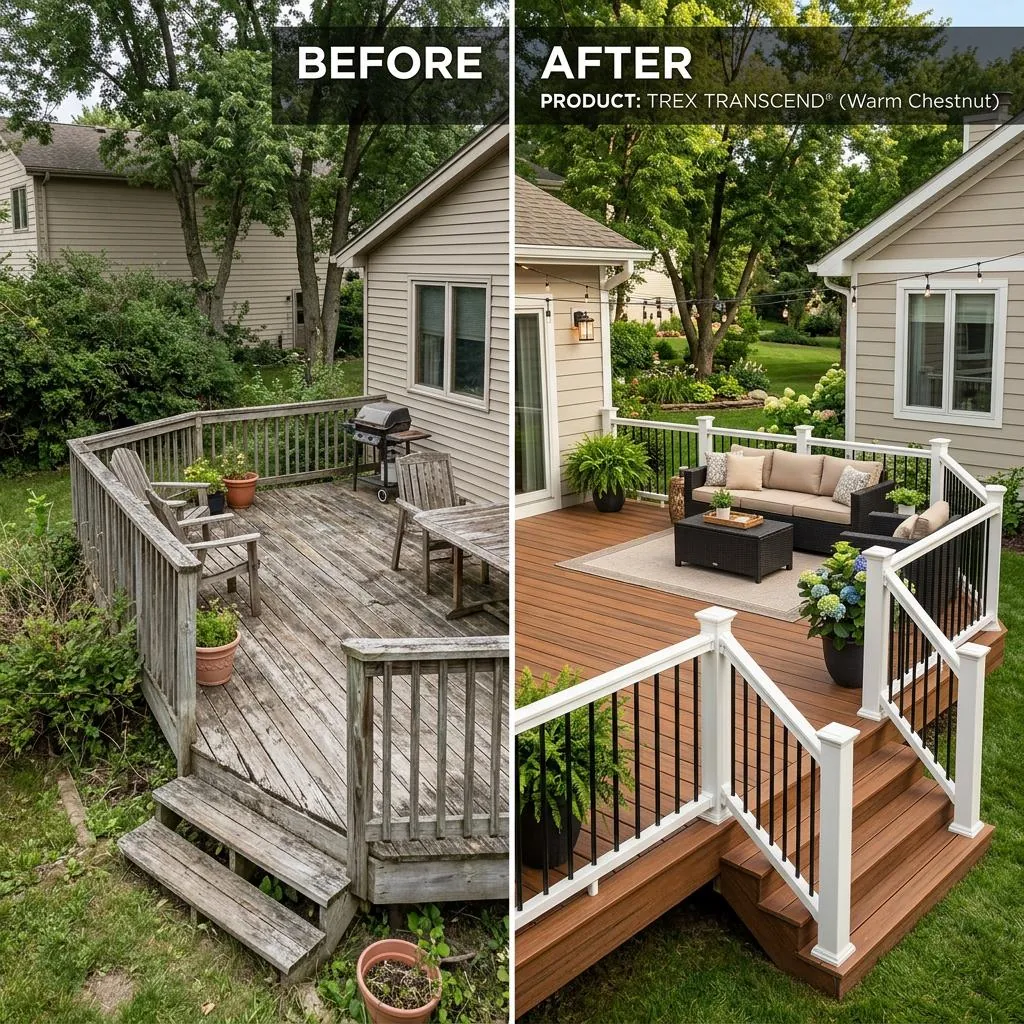
If you are planning a new deck in Pennsylvania, one question comes up before almost every other: composite or wood? Wood has been the standard for generations, and it still has real advantages in price and natural character. Composite has grown quickly because it promises a deck that looks good with far less work. Both can be excellent. The right choice depends on your budget, how much time you want to spend on maintenance, how your deck is exposed to sun and shade and how long you plan to stay in the home.
This guide to composite vs. wood decking compares cost, lifespan, upkeep, comfort, safety and winter performance in Central Pennsylvania conditions. It comes from Haven Builders, a locally owned construction and remodeling company that builds and replaces decks for homeowners in Williamsport, Lock Haven and State College.
The Short Answer
Choose pressure-treated wood if upfront cost is your top priority and you are willing to clean and seal the deck on a regular schedule. Choose composite or PVC if you want a deck that stays looking good with little more than washing, and you are comfortable paying more at the start for lower maintenance later. Cedar sits in between, with a premium look and moderate upkeep. If you are unsure, the comparison below and the questions at the end will help you decide.
Upfront Cost
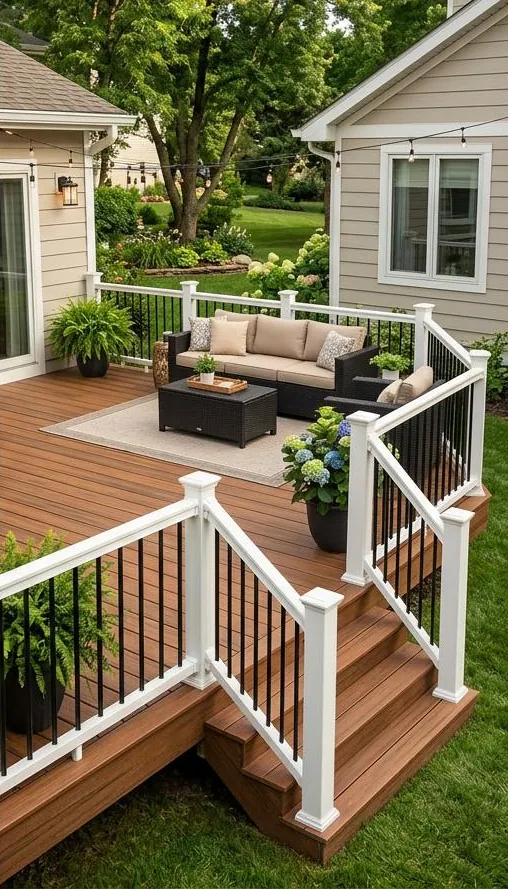
Wood is cheaper to buy and install. Pressure-treated pine is the least expensive decking, and it is widely available. Cedar and redwood cost more because of their natural resistance to decay and their appearance. Composite boards typically cost two to three times as much as pressure-treated lumber per board, and PVC costs even more. In installed terms, many projects land around $30 to $50 per square foot for pressure-treated pine, $40 to $65 for cedar, $55 to $90 for composite and $65 to $100 for PVC, before special features. Framing, footings, railings and stairs add to the total, and railings can account for a large share on elevated decks.
Remember that the board surface is only one part of the cost. A high-quality deck needs the same strong footings, framing and flashing no matter what you put on top. A builder who offers a rock-bottom bid by skimping on those hidden parts is not giving you a better deal. Our deck building guide explains what a proper structure includes.
Lifespan and Warranty
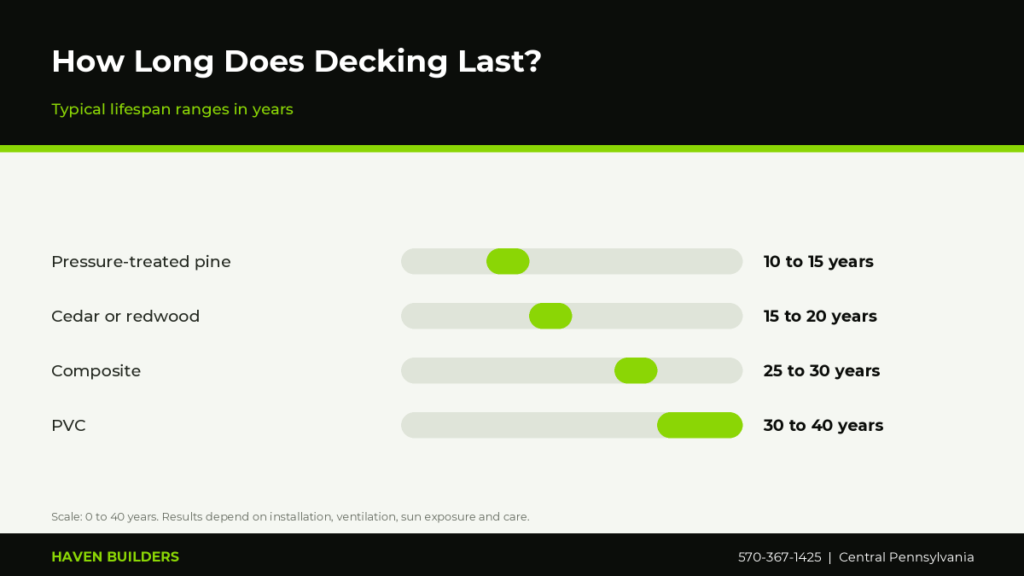
Pressure-treated pine commonly lasts 10 to 15 years when it is maintained and installed with good ventilation. Cedar can last 15 to 20 years. Composite boards often carry manufacturer warranties of 25 years or more, and PVC may last 30 years or longer. Keep in mind that a warranty covers the product under specific conditions. It typically does not cover labor, improper installation or damage from neglect, and fade and stain coverage varies by brand. Read the fine print and keep your records.
Maintenance: The Biggest Difference
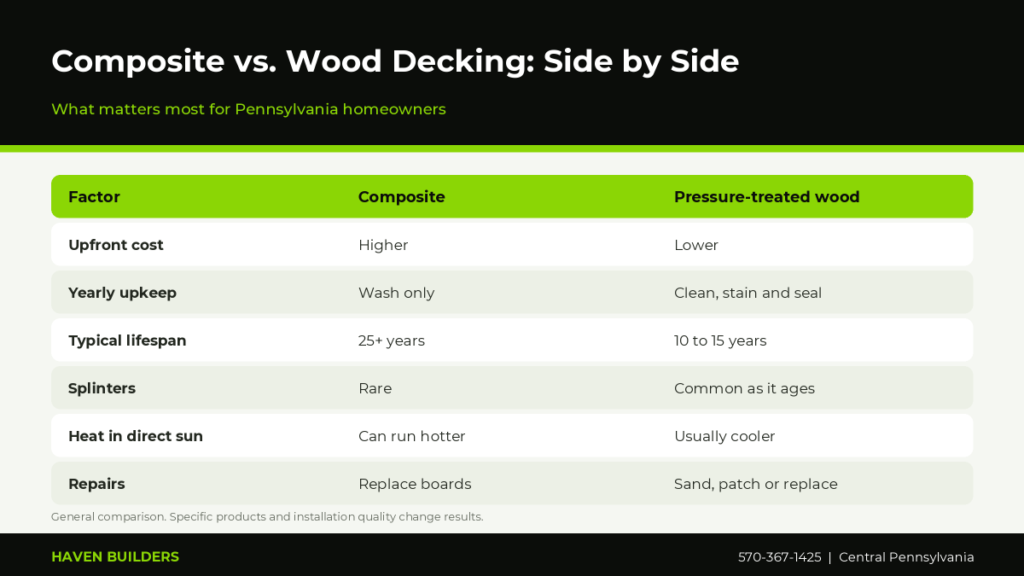
Wood decks need regular care to look their best. That usually means cleaning once or twice a year, then applying a water-repellent sealer or stain every one to three years. If you skip that work, boards gray, cup, crack and splinter, and mildew can take hold on shaded sections. Many homeowners enjoy the ritual of refreshing the deck each spring, while others find it a chore that never gets done.
Composite and PVC decks do not need staining or sealing. A few washes a year with soap and water usually keeps them clean. They can still show mildew in damp shade, and food and grease stains should be wiped up quickly, but the work is far lighter. Over a decade or two, the time and money saved on sealers, stains and cleaning supplies can offset a large part of the higher purchase price.
How Each Material Handles Pennsylvania Weather
Freeze and Thaw
Our region sees repeated freezing and thawing from late fall through early spring. Wood absorbs and releases moisture, which causes boards to swell, shrink, check and loosen fasteners over time. Composite absorbs far less water and holds its shape, although it expands and contracts slightly with temperature, which is why proper gapping at board ends and edges is essential.
Snow and Ice
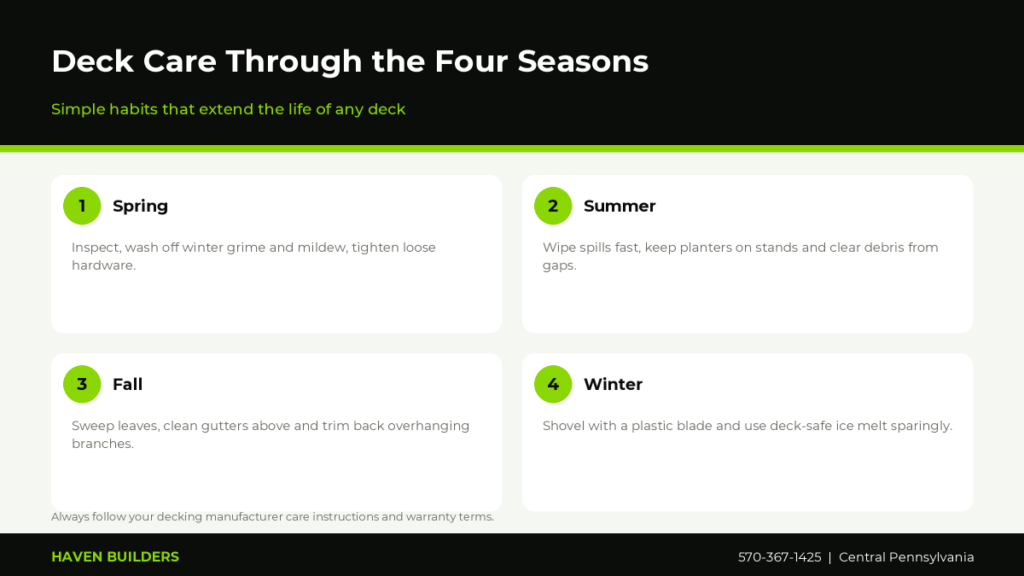
Both materials need a gentle approach. Shovel with a plastic blade and avoid metal tools that can scrape or gouge. Deck-safe ice melt used sparingly is better than heavy rock salt. Textured composite surfaces generally offer good traction, and wood can be slick when it is coated with ice or algae, so keep it clean.
Sun, Shade and Heat
Dark composite boards can become noticeably hot on bare feet in full July sun, since the material absorbs heat. Lighter colors and some newer cool-touch products help. Wood generally stays a little cooler. In deep shade, moisture and mildew are the bigger concern, and PVC or capped composite tends to do well there.
Comfort, Safety and Appearance
Wood has natural warmth, grain and scent that many people love, and it can be painted or stained in nearly any color. As it ages it can splinter, so check boards in spring. Composite offers consistent color, realistic grain and no splinters, and the newest products are hard to tell from wood at a glance. Some lower-end composites can look plasticky or show wear patterns, so choose a capped product from a reputable brand and look at full-length samples outdoors.
For safety, pay attention to traction and railing details no matter what material you use. Guards are typically required on decks more than 30 inches above grade, and stairs need consistent risers and handrails. Your local code office makes the final call.
Installation Differences That Matter
- Joist spacing. Many composite brands require joists spaced closer together, often 16 inches on center or less, and tighter when boards run diagonally.
- Fasteners. Composite uses hidden clips or special screws that allow for movement. Wood is usually face-screwed.
- Gapping. Composite must be gapped correctly at ends and edges to allow for expansion. Wood gaps change as boards dry.
- Ventilation. Both materials last longer when air can circulate under the deck. Closed-in or low-to-the-ground decks need special attention.
- Framing life. Composite boards can outlast a pressure-treated frame. Using protective tape on joists and quality fasteners helps the structure match the surface.
Because installation details vary by brand, use a builder who follows the manufacturer instructions to the letter. That also protects your warranty.
Cost of Ownership Over 20 Years
It helps to think in terms of total cost. A wood deck costs less to build, but you will pay for cleaners, sealers, stain, brushes and sometimes professional help every year or two, and you may need to replace boards or the entire surface within 15 years. A composite deck costs more to build but typically needs far less ongoing spending, and the surface may last twice as long. If you plan to sell in the next few years, an attractive wood deck can still be a selling point, but buyers increasingly appreciate a low-maintenance outdoor space.
This video walks through the cost and performance tradeoffs in a few minutes.
Video: Composite vs Wood Decking (Advantage Lumber on YouTube)
Three Common Scenarios and the Choice That Fits
It can help to see how the decision plays out in real homes. These are composite examples based on the kinds of projects we see around Central Pennsylvania, not specific customers.
The Busy Family With a Sunny Back Deck
A household with two working parents, kids and a dog wants a place to grill, eat outside and let the dog out. They have no interest in spending weekends staining boards. A capped composite deck in a lighter color is a strong fit. It resists scratches and stains, handles spills and stays comfortable underfoot. They accept the higher price because it saves time every year.
The Budget-Minded Homeowner Replacing a Small Deck
A homeowner with a small 10 by 12 foot deck wants a safe, good-looking surface at the lowest reasonable cost. Pressure-treated pine on a new, properly built frame makes sense. They plan to clean and seal it every other year and understand they may replace boards in about a decade. Because the deck is small, the maintenance workload is manageable.
The Shaded, Damp Side Yard
A deck under tall trees stays damp, collects leaves and grows mildew quickly. Wood in that setting needs frequent cleaning and tends to deteriorate faster. Capped composite or PVC with good ventilation underneath is the better choice, paired with a regular sweep to keep debris out of the gaps.
Which Option Fits Your Situation?
- Lowest budget, willing to maintain: pressure-treated pine with a quality sealer routine.
- Natural look and character: cedar or redwood, accepting the care that comes with it.
- Busy household, long-term home: composite for the best balance of cost and low upkeep.
- Shaded, damp or very high-use deck: capped composite or PVC for maximum moisture resistance.
- Tight budget but wanting less upkeep: consider a hybrid with a strong pressure-treated frame and composite boards on the walking surface.
Environmental and Practical Considerations
Many composite boards contain recycled wood fibers and plastic, which keeps material out of landfills, and they eliminate the need for chemical sealers. Pressure-treated lumber is a renewable resource, but it is treated with preservatives, and stains and sealers add to its chemical footprint. At the end of life, wood can often be chipped or repurposed, while composite recycling options vary by manufacturer and region. If sustainability is important to you, ask suppliers about recycled content, take-back programs and certifications, and weigh the longer service life of a composite deck against the lower initial footprint of local lumber.
On the practical side, composite boards are heavier and need careful handling, and cut edges should be treated according to the manufacturer. Wood is easier to modify later, which is helpful if you expect to add a stair or a pergola. Whichever option you pick, buy from a reputable supplier, order a small amount extra for future repairs and save the leftover boards so color matches if you ever need to replace a section.
Permits, Replacement and Next Steps
Whichever material you choose, many decks need a permit, especially when attached to the house or elevated. See our guide to home remodeling permits in Pennsylvania. If you are replacing an old deck, a builder can often reuse sound footings and framing. To plan your project and compare bids, review how to hire a remodeling contractor, and see our finished deck projects on Our Work. When you are ready, request a free estimate or call 570-367-1425.
Why Choose Haven Builders for Your Deck
We are a locally owned company that treats every home as if it were our own. You get honest estimates, dependable scheduling, clear communication and quality workmanship from first measurement to final cleanup. Learn more on our About page.
Frequently Asked Questions
Is composite decking better than wood?
Composite is better for low maintenance and long life, while wood is better for lower upfront cost and natural character. Neither is universally better. The right choice depends on your budget and how much upkeep you want.
How much more does composite decking cost than wood?
Composite boards often cost two to three times as much as pressure-treated boards, and installed projects commonly run roughly $55 to $90 per square foot versus $30 to $50 for pressure-treated pine. Framing, railings and stairs are in addition.
Does composite decking get hot in the sun?
It can, especially in dark colors and full sun. Lighter colors and cool-touch products stay more comfortable. Wood usually stays cooler.
Does composite decking fade or stain?
Quality capped composite resists fading and staining, but some color change in the first months is normal. Wipe up spills promptly and follow the manufacturer cleaning instructions.
How often do I need to seal a wood deck?
Most wood decks need cleaning once or twice a year and sealing or staining every one to three years, depending on the product and sun exposure.
Is composite decking slippery in winter?
Textured composite offers good traction, but any deck can become slick with ice, snow or algae. Clear snow promptly with a plastic shovel and use deck-safe ice melt sparingly.
Can I put composite boards on my existing deck frame?
Sometimes. The frame must be sound, level and built to the manufacturer joist spacing requirements. A builder should inspect the footings, ledger and joists before you commit.
Can Haven Builders build composite or wood decks?
Yes. Haven Builders builds and replaces decks across Central Pennsylvania, including Lock Haven, Williamsport and State College. Call 570-367-1425 for an estimate.
Ready to Start Your Project?
Haven Builders is a locally owned construction and remodeling company serving homeowners across Central Pennsylvania, including Williamsport, Lock Haven and State College. Tell us what you have in mind and we will give you a clear, honest estimate.
Want a website that brings in local leads? Abbabeelweb is a web design, WordPress development and SEO studio that builds fast, search-optimized websites and ranking-focused blog content for contractors, remodelers and other local service businesses, from custom Elementor design and on-page SEO to technical clean-up and content strategy. Visit abbabeelweb.com to see our services, or hire us on Fiverr to get started.